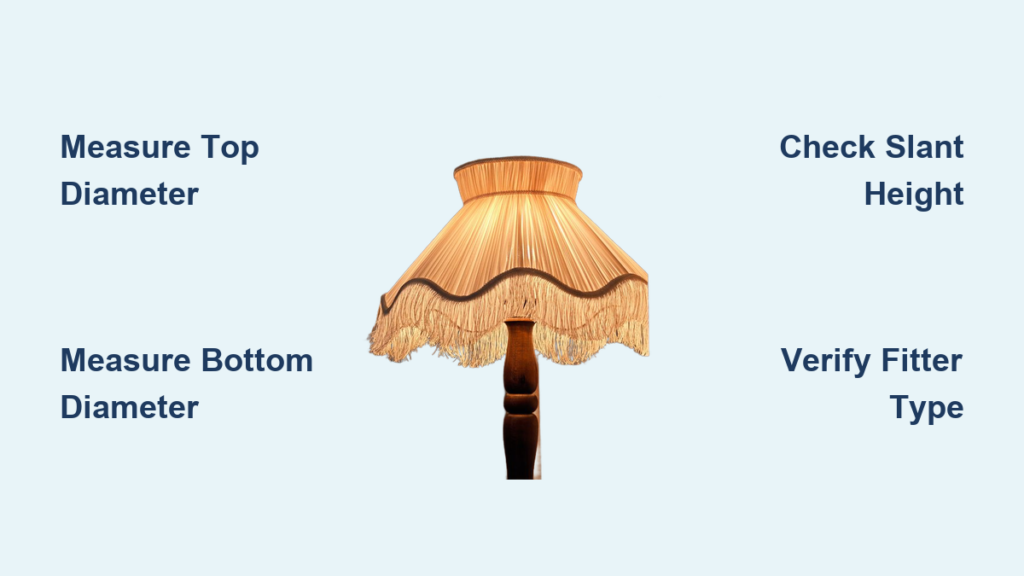
You’ve found the perfect lamp base, but the shade doesn’t fit right, or maybe you’re replacing a worn-out shade that finally gave out. Whatever your reason, knowing how to measure lamp shade dimensions accurately is the difference between a seamless, stylish fit and a frustrating return trip. A poorly sized shade can make your lamp look top-heavy, sit at the wrong height, or even wobble dangerously on the base.
This guide walks you through every step: the four essential measurements, how to identify your fitter type, proportion rules for visual balance, and pro tips to avoid common mistakes. With the right technique, you can measure any lamp shade in minutes and shop with complete confidence.
Key Dimensions to Measure for a Perfect Fit
To find a compatible shade, you need four precise measurements. These numbers tell you not only if a shade will physically fit your lamp but also how it will look once installed.
Top and Bottom Diameter
Start with the top diameter, which is the width across the top opening measured from inside edge to inside edge. Then measure the bottom diameter the same way. The bottom opening is typically larger, and this measurement is often used to name the shade size.
Why it matters: Retailers commonly refer to shades by their bottom diameter, but both measurements must match your lamp’s proportions. A shade labeled “16-inch” refers to the bottom width.
Slant Height vs. Vertical Height
For tapered shades that narrow toward the top, measure the slant height, which is the diagonal distance along the outer edge from the top rim to the bottom rim. For drum shades with straight sides, measure the vertical height instead, which is the straight distance from top to bottom.
Visual cue: If the side forms a 90-degree angle with the base, use vertical height. If it angles inward, use slant height.
Step-by-Step Measurement Process
Follow these steps to get accurate, reliable numbers every time you need to measure lamp shade dimensions.
Remove the Shade Safely
Turn off the lamp and let the bulb cool completely. Gently unscrew the finial and lift the shade off the harp. If it’s a clip-on shade, unclip it from the bulb. This prevents distortion and ensures you can measure on a flat surface.
Use the Right Tools
Choose a metal ruler or rigid tape measure. Avoid cloth tapes because they stretch and give false readings. For oval or rectangular shades, measure both length and width at the top and bottom openings.
Measure Inside to Inside
Place the shade upside down on a flat surface. Measure across the center of the top and bottom openings from inside edge to inside edge. This ensures compatibility with the harp or fitter.
Common mistake: Measuring from the outer edges adds a half inch to one inch of extra width, leading to a shade that’s too small to fit your lamp.
Record All Four Numbers
Write down the top diameter, bottom diameter, and either slant height or vertical height depending on your shade style. For example, a shade labeled 8″ × 16″ × 10″ means 8 inches at the top, 16 inches at the bottom, and 10 inches in height.
Identifying Your Lamp Shade Fitter Type
:max_bytes(150000):strip_icc()/types-of-lampshade-fittings-6742943-final-2-53530431336341488a799406cb5c33a5.png)
Even perfect dimensions won’t help if the fitter doesn’t match your lamp. There are three main types, and you must know which one your lamp uses before shopping for replacements.
Spider Fitting
This is the most common fitter type for table and floor lamps. The shade sits on the harp, and a finial screws onto the socket to hold it in place. If your shade sits too high or low, you can replace the harp with a different height.
Uno Fitting
This harp-free design slides directly over the socket and secures with a screw ring. Uno fittings are common in modern, low-profile lamps and swing-arm reading lights. These shades have a smaller inner diameter, so measure your socket diameter carefully to ensure compatibility.
Clip-On Fitting
A small wire clip attaches directly to the light bulb. This type is used for chandeliers, sconces, and decorative accent fixtures. Use only with low-wattage bulbs to avoid overheating, and expect sizes typically ranging from 3 to 6 inches in diameter.
Critical check: Never assume the fitter type. Look at your current shade or lamp base to confirm before purchasing.
Proportion Rules for Visual Balance

A shade can fit perfectly but still look wrong if the proportions are off. Use these rules to ensure harmony between the shade and your lamp base.
Shade Width Proportion
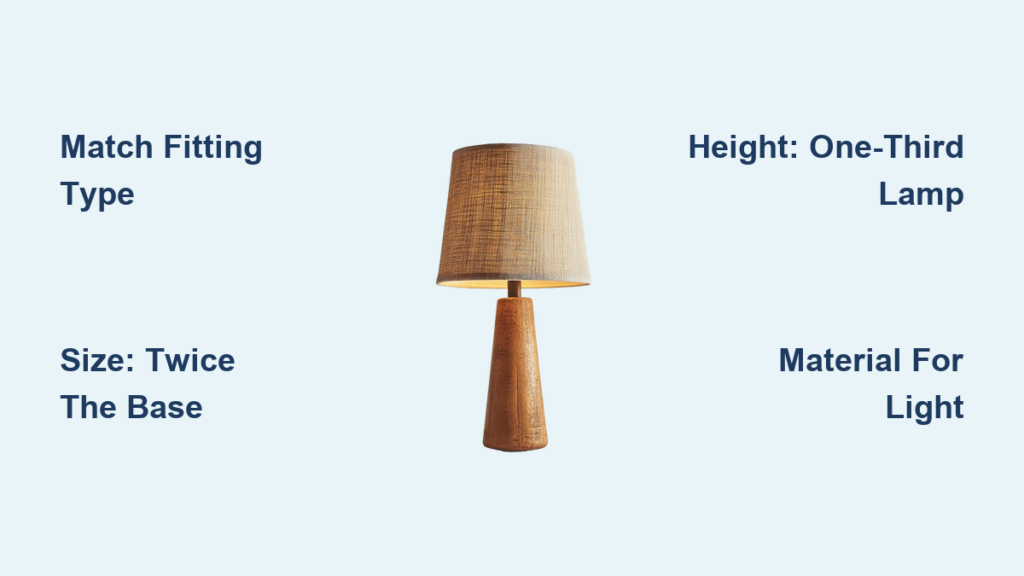
The shade’s bottom diameter should be roughly twice the width of the lamp base. For example, if your base is 8 inches wide, aim for a 16-inch wide shade. This prevents a top-heavy or awkward appearance.
Exception: For tall buffet lamps or pairs on a console, a slightly narrower shade at 1.5 times the base width may look more balanced.
Shade Height Proportion
The shade height should be about two-thirds of the lamp base height measured from the floor to the socket. Once installed, the shade should hide the harp and most of the socket. If you can see the bottom of the harp, the shade is too short or the harp is too tall.
Fix it: Swap the harp for a shorter or taller version. Replacement harps are inexpensive and easy to install.
Understanding Size Tolerances
Need a replacement but cannot find the exact size? Small variances are generally acceptable, but there are guidelines to follow.
Allow 1-2 Inches of Flexibility
A 1 to 2 inch difference in diameter or height is usually fine, especially in casual settings. But for matched pairs or formal spaces, exact dimensions are best. Even a half-inch difference will be noticeable when comparing two lamps side by side.
Prioritize Visual Fit
Room scale, ceiling height, and furniture size can justify breaking the standard rules. A high-ceilinged room may need a taller shade even if it exceeds the two-thirds base height proportion.
Pro tip: Take a photo of your lamp with a temporary paper shade cut to your desired size before buying the real thing.
Tools and Techniques for Precision
Get accurate measurements the first time with these expert-recommended practices.
Use Rigid Measuring Tools
Flexible cloth tapes bend and stretch, compromising accuracy. A metal ruler or steel tape measure gives straight, precise lines every time.
Measure Oval and Rectangular Shades Fully
For non-round shades, record both length and width at the top and bottom. For example, you might see measurements like 12 inches by 16 inches at the top and 14 inches by 18 inches at the bottom.
Estimate Without a Shade
If the original shade is lost or broken, measure the harp height and base width. Apply the proportion rules to estimate your ideal shade size, then verify with photos when shopping.
Take Reference Photos
Snap pictures of your lamp from the front and side. Include a ruler next to the harp or socket for scale. Retailers often ask for these when helping with fit recommendations.
How to Shop With Your Measurements

Now that you have all the numbers, here is how to use them when shopping for your new shade.
Filter Online by Exact Specs
On retailer websites, use filters for bottom diameter, top diameter, height, and fitter type. Saving your measurements in your phone notes makes browsing much faster.
Compare Product Details Carefully
Do not just trust the product name. Click into the specifications tab and confirm the top by bottom by height matches exactly, the fitter type is correct, and any required hardware is included.
Watch Installation Videos
Still unsure? Watch shade fitter tutorials on YouTube. Seeing the parts in motion helps you identify your fitter type and learn proper installation technique.
Buy Hardware Separately If Needed
If your new shade requires a different harp or finial, purchase them at the same time. Many kits include both, ensuring a complete and secure fit.
Where to Get Additional Help
Need hands-on support? Several resources can assist you.
Visit a Lampshade Library
The Lampshade Library in Charleston, South Carolina offers in-person assistance. Their address is 141 Market Street, Charleston, SC 29401. Hours are Monday through Saturday, 10 AM to 5 PM, with Sunday closed or by appointment only.
Use Video Guides
Many retailers offer free tutorials on measuring a lamp shade, identifying fitter types, and installing spider and uno shades. Search for shade measurement guides on YouTube.
Contact Customer Support
Upload photos and your measurements to a retailer’s support team. Many offer personalized fit recommendations, which is especially helpful for rare or vintage lamps.
Frequently Asked Questions About Measuring Lamp Shade Dimensions
What are the four measurements needed for a lamp shade?
You need the top diameter, bottom diameter, slant height for tapered shades, and vertical height for drum shades. All four ensure a proper fit and help you find the right replacement.
How do I measure a lamp shade that is tapered?
For tapered shades, measure the slant height along the diagonal from the top outer edge to the bottom outer edge. This gives you the true height for shades that narrow toward the top.
What is the difference between slant height and vertical height?
Slant height is the diagonal measurement along the side of a tapered shade. Vertical height is the straight vertical distance from top to bottom, used for drum shades with straight sides.
How do I know which fitter type my lamp uses?
Examine how your current shade attaches. A spider fitter uses a harp and finial. An uno fitter slides over the socket directly. A clip-on clips onto the bulb itself.
Can I use a shade that is slightly different in size?
Yes, a 1 to 2 inch difference is generally acceptable. However, for formal settings or matched pairs, exact dimensions are recommended to avoid noticeable differences.
What proportion should the shade be to the lamp base?
The shade width should be approximately twice the base width, and the shade height should be about two-thirds of the lamp base height from floor to socket.
Final Takeaways for Measuring Lamp Shade Dimensions
Measuring lamp shade dimensions does not have to be complicated. With the right tools and this step-by-step guide, you will find a shade that fits perfectly both mechanically and aesthetically. Remember to measure inside to inside, identify your fitter type, and apply proportion rules for visual balance. Take photos, record all four key measurements, and verify compatibility before purchasing. Now you are ready to shop with confidence and transform your lighting with the perfect shade.