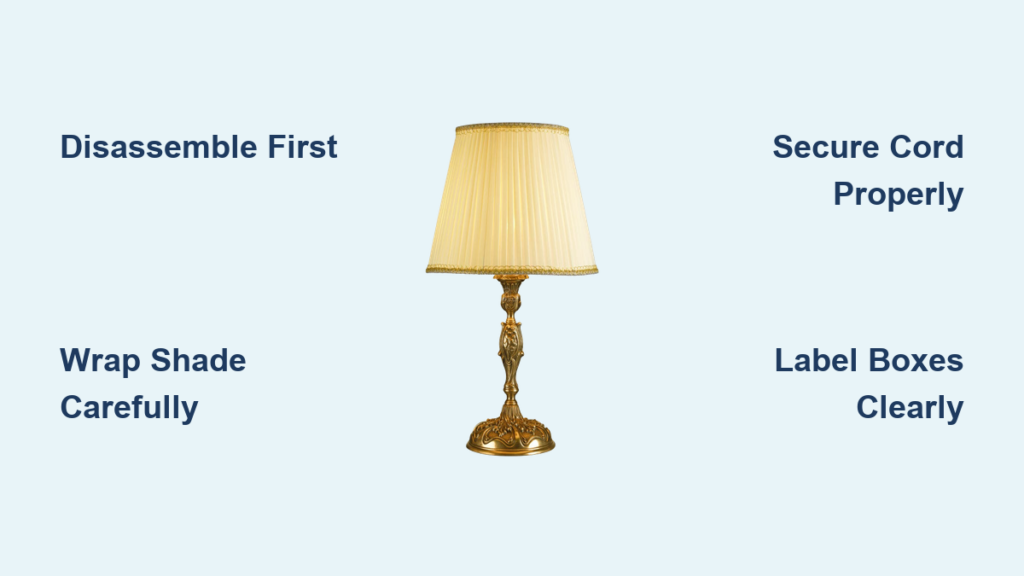
Moving a lamp might seem simple, but if you have ever unpacked a shattered shade or untangled a frayed cord, you know the heartbreak of improper packing. The truth is, how to pack a lamp for moving safely requires careful disassembly, the right materials, and smart organization. Whether it is a vintage table lamp, a towering floor model, or a delicate chandelier, one wrong move can mean permanent damage. This guide gives you a proven, step-by-step method to protect every component, so your lamp arrives intact and ready to light up your new space.
You will learn exactly what to do and what not to do to avoid common pitfalls like ink-stained shades, lost screws, and crushed frames. From the right wrapping materials to how to label boxes for movers, we cover every detail based on real-world packing standards. No guesswork. No last-minute hardware hunts. Just clear, actionable steps that ensure your lamps survive the move unscathed.
Disassemble the Lamp Safely
Before wrapping or boxing, take the lamp apart completely. This prevents stress on fragile joints and reduces the risk of internal damage during transit. Working on one lamp at a time also prevents mixing up parts between different fixtures.
Remove Bulb and Shade First
Start by unplugging the lamp and removing the light bulb. Wrap each bulb individually in bubble wrap or packing paper and place them in a sealed plastic bag labeled “lamp bulbs.” Store this bag in the same box as the lamp base, never in kitchenware or dish boxes.
Next, detach the lampshade. Most shades are held by a harp and secured with a finial. Gently unscrew or lift off the finial, then slide the harp out of the socket. Set both aside with other small parts.
• Remove the light bulb first and wrap it separately
• Detach the lampshade by releasing the harp and finial
• Work on one lamp at a time to avoid mixing parts
Pro Tip: Reinsert the finial screw into the top of the socket after removing the shade. This prevents loss and keeps the socket protected.
Save All Hardware Together
Small parts like harp, finial, screws, and caps are easily misplaced. Place them all in a small labeled bag or container. Tape this bag to the inside of the lamp base box or place it in a dedicated hardware envelope. For multiple lamps, label each bag clearly with the lamp name or room location.
• Collect harp, finial, screws, washers, and caps
• Place in a sealed plastic bag labeled with lamp name
• Tape bag to inside of base box or use a hardware envelope
Pack the Lamp Base Securely

The base is often the heaviest part, but it is still vulnerable, especially if made of ceramic, glass, or delicate finishes. Proper wrapping and boxing prevent chips, cracks, and surface damage.
Wrap Base in Bubble Wrap
Lay the base on a flat surface and wrap it completely in bubble wrap, using larger bubbles for better cushioning. Roll the lamp gently to avoid creasing the wrap. Secure with tape at the seams, but do not tape directly over painted or glossy surfaces. Use tape only on the wrap itself.
For extra protection, wrap the base again in a bath towel, moving blanket, or foam padding, especially if the base has ornate details or protrusions.
• Use bubble wrap with large bubbles for better protection
• Roll the lamp gently to wrap all surfaces
• Do not tape directly over painted or glossy finishes
• Add a second layer with towels or moving blankets for ornate bases
Coil Cord Without Damage
Never tape the cord directly to the lamp. Adhesives can degrade insulation or leave residue. Instead, loosely coil the cord and secure it with a twist tie, soft string, or velcro strap. Keep the coil snug but not tight to prevent kinking.
• Never use tape directly on cords
• Use twist ties, soft string, or velcro straps instead
• Keep coils loose to prevent kinking
Box Base Upright or Flat
Place the wrapped base base-down in a sturdy box that is at least two inches larger on all sides. If the lamp is tall or narrow, pack it on its side to fit better, but ensure it is fully supported.
Use crumpled packing paper, towels, or soft fillers to fill all gaps. The lamp should not shift more than half an inch when you shake the box gently.
• Place base-down in a box with two inches of space on all sides
• Pack tall lamps on their side if needed
• Fill all voids with crumpled paper or soft items
• Test by shaking gently; lamp should not move more than half an inch
Warning: Never pack lamp bases with dishes, books, or heavy items. The weight can crack or chip the base during transit.
Protect Lamp Shades with Care
Lamp shades are the most fragile part. Even slight pressure can cause warping, creasing, or permanent stains. Special handling prevents costly damage.
Avoid Newsprint at All Costs
Never use printed newspaper to wrap or line lamp shades. Ink can transfer onto fabric, especially off-white, silk, or linen shades, causing irreversible discoloration. Always use non-inked materials like tissue paper, pillowcases, or clean towels.
Wrap in Tissue or Fabric
Wrap each shade in three to four layers of tissue paper, or use a clean pillowcase, or wrap in a lightweight cotton towel. Handle shades with clean, dry hands to prevent oil stains. Avoid touching the interior surface if possible.
• Use tissue paper, pillowcases, or clean towels
• Wrap in three to four layers minimum
• Handle with clean, dry hands only
Use Rigid, Sized Boxes
Choose a sturdy, rigid box that is at least two inches larger than the shade on all sides. Line the bottom with crushed packing paper for cushioning.
Place the wrapped shade in the center of the box. Do not pack material tightly around the sides, as this creates pressure points. Instead, leave space and fill voids above and below with soft padding.
• Select a box two inches larger than the shade on all sides
• Line bottom with crushed packing paper
• Place shade in center without tight side pressure
• Fill voids above and below only
Stack and Nest Safely
You can stack shades vertically if separated by flat layers of bubble wrap or balled-up paper. A smaller shade may nest inside a larger one, but only if they do not touch. One silk or pleated shade per box is ideal to prevent stretching and friction damage. Never over-pack. The box must close without compressing the shades.
• Stack vertically with protective layers between
• Smaller shades may nest inside larger ones if not touching
• One silk shade per box maximum
• Box must close without force
Critical: Lampshade boxes must be stored upright during transport. Never place anything on top.
Handle Bulbs and Small Parts
Light bulbs and tiny hardware are easy to lose or break if not packed correctly. Proper organization prevents both damage and frustration.
Wrap Bulbs Individually
Each bulb should be wrapped in bubble wrap or several layers of packing paper. LED and incandescent bulbs are especially fragile. Compact fluorescent bulbs may contain mercury, so check local regulations before transporting.
• Wrap each bulb separately in bubble wrap or paper
• Handle LED and incandescent bulbs with extra care
• Check local regulations for CFL bulbs containing mercury
Store Hardware in Labeled Bags
Place all small parts, including harp, finial, screws, and washers, in a sealed plastic bag labeled with the lamp name or location. Tape this bag to the inside of the base box or pack it in a central hardware container.
Expert Note: If you have multiple lamps, take a photo of each one before disassembly. This helps with reassembly and ensures parts are not mixed up.
Seal and Label Boxes Properly
A well-packed lamp can still be damaged if the box fails or is mishandled. Proper sealing and labeling ensure movers handle boxes with care.
Use H-Taping Method
Seal all seams with strong packing tape using the H-method. Apply tape along all seams vertically and horizontally for maximum strength. Reinforce corners if the box feels weak.
Label for Fragility and Orientation
Clearly mark each box with “Fragile” in bold letters, “This End Up” if the box has a correct orientation, and specific contents like “Contains Lamp Base” or “Lampshades, Do Not Stack.” Use black marker on white tape for high visibility.
• Mark clearly with “Fragile” in bold letters
• Add “This End Up” if orientation matters
• Specify contents like “Contains Lamp Base”
• Use black marker on white tape for visibility
Real-World Tip: Movers are more likely to handle boxes carefully when labels are clear and specific. “Fragile” alone is not enough. Tell them what is fragile.
Pack Special Lamp Types

Different lamps require different strategies. Here is how to handle the most common variations safely.
Table Lamps
Most table lamps are fully disassemblable. Pack base, shade, bulb, and hardware in separate, labeled boxes. Use small to medium boxes depending on size. Never mix with dishware.
Floor Lamps
Break into parts, including base, pole sections, socket head, and shade. Wrap each piece individually. Use long, narrow boxes or mailing tubes for pole sections if possible.
If the lamp cannot be disassembled, wrap the entire unit in moving blankets and secure with tape. Transport vertically if possible, never lay flat under weight.
Chandeliers
Disassemble completely, including arms, crystals, canopy, chain, and wiring. Wrap each crystal in individual bubble wrap pouches. Use foam inserts or custom crates for high-value fixtures.
Pack components in a reinforced, corrugated box with shock-absorbing padding on all sides. Label clearly and consider professional packing for antique or expensive models.
Optimize for Transport and Storage
Even perfect packing fails if boxes are stored or loaded incorrectly. Follow these guidelines to protect your packed lamps.
Load Lamp Base Boxes Safely
Lamp base boxes can be stacked carefully if packed tightly. Always place them below heavier items, never under furniture or appliances. Keep away from high-traffic loading zones.
Keep Shade Boxes Upright
Lampshade boxes must be stored upright at all times. Never lay flat or stack anything on top. Place them near the top of the truck load or against a wall for protection.
Use plastic bins with lids if moving in rain or humid conditions for added moisture resistance.
Avoid Environmental Damage
Keep all lamp boxes away from direct sunlight, which can fade fabric shades, extreme heat or cold, which can warp materials, and moisture, which can cause mold or paper adhesion. If storing long-term, place boxes in a climate-controlled unit and elevate off the floor.
• Keep away from direct sunlight
• Avoid extreme temperatures
• Protect from moisture and humidity
• Store in climate-controlled space if long-term
Prevent Common Packing Mistakes
Even experienced movers make errors that lead to damaged lamps. Avoid these six critical mistakes to ensure safe arrival.
• Using newsprint on shades, which causes irreversible ink transfer
• Taping cords directly to the lamp, which damages insulation and coating
• Over-packing shade boxes, which causes distortion and warping
• Mixing lamps with heavy items like books, dishes, or tools
• Skipping labels, which leads to mishandling
• Forgetting to reinsert the finial screw, which causes hardware loss
Pro Tip: Taking photos before disassembly helps with reassembly and prevents mixing parts between different lamps.
Frequently Asked Questions About Packing Lamps for Moving
Can I pack lamp shades with newspaper?
No, never use printed newspaper on lamp shades. Ink can transfer permanently onto fabric, especially on off-white, silk, or linen shades. Always use tissue paper, pillowcases, or clean towels instead.
Should I keep the lamp base upright in the box?
Yes, place the lamp base base-down in the box when possible. If the lamp is tall or narrow, you can pack it on its side, but ensure it is fully supported and cannot shift during transit.
How do I prevent losing small hardware like screws and finials?
Reinsert the finial screw into the lamp socket immediately after removing the shade. Store all hardware in a sealed plastic bag labeled with the lamp name, and tape the bag to the inside of the base box.
Can I stack lamp shade boxes?
No, never stack anything on top of lampshade boxes. Store them upright at all times. You can stack multiple shade boxes vertically if separated by protective layers, but nothing should be placed on top.
What is the best way to test if my lamp is packed securely?
Shake the box gently after sealing. If the lamp moves more than half an inch, add more packing material. The lamp should be immobilized to prevent internal damage.
Should I transport light bulbs with the lamp?
Wrap each bulb individually and store them in the same box as the lamp base. Use a sealed plastic bag to prevent breakage and keep bulbs together with their corresponding lamp.
Key Takeaways for Packing Your Lamp Safely

Packing a lamp for moving does not have to be stressful. With the right supplies, clear steps, and attention to detail, you can protect even the most delicate fixtures. Focus on complete disassembly before packing, use non-inked wrapping materials like tissue paper or pillowcases for shades, and secure cords without using tape. Always label boxes with specific contents, fragility warnings, and orientation indicators. Keep shade boxes upright and never stack anything on top. Lamp base boxes can be stacked carefully if packed tightly, but always place them below heavier items. Whether it is one lamp or a whole house full, this method ensures safe arrival every time.
When you unpack, you will not be sorting through shattered glass or hunting for lost screws. You will be turning on the light in your new home, just like before.