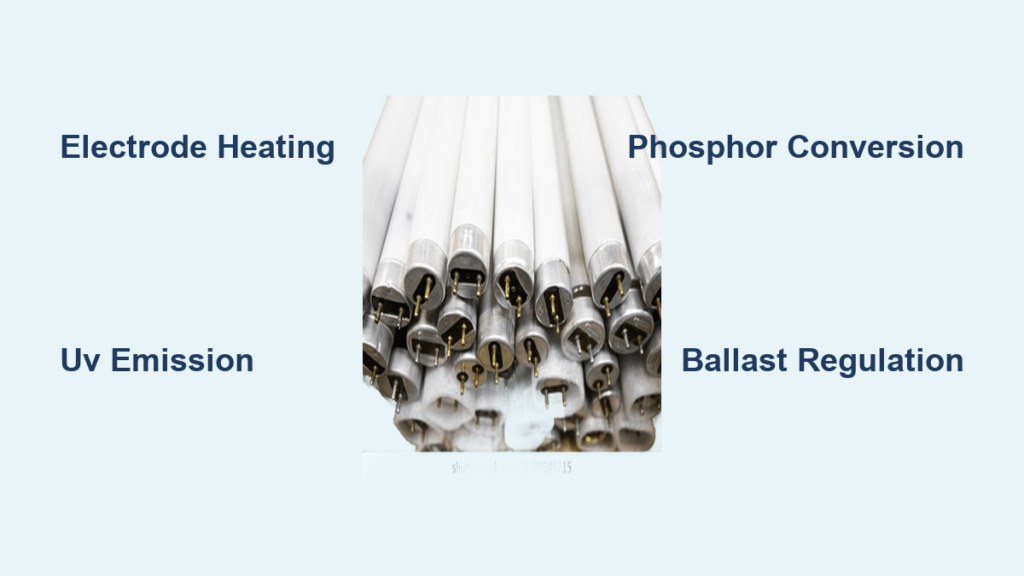
You flip the switch, and in a second or two, the fluorescent tube lights up, cool and bright. But what is actually happening inside that long glass tube? Unlike an incandescent bulb that glows like a tiny heater, a fluorescent lamp uses a sophisticated chain reaction involving invisible ultraviolet light, mercury vapor, and special coatings to produce illumination. Understanding how a fluorescent lamp works reveals a fascinating interplay of physics and engineering that made it a lighting staple for decades.
At its core, a fluorescent lamp converts electricity into visible light through gas discharge, UV emission, and phosphor fluorescence. It does not rely on a glowing filament. Instead, it sends an electrical current through mercury vapor, generating ultraviolet light. This invisible UV light then strikes a coating on the inside of the tube, which absorbs it and re-emits the energy as visible light. The entire process is far more efficient than traditional bulbs, which is why offices, schools, and factories once relied on them so heavily.
The Step-by-Step Light Generation Process
Electrode Heating and Electron Emission
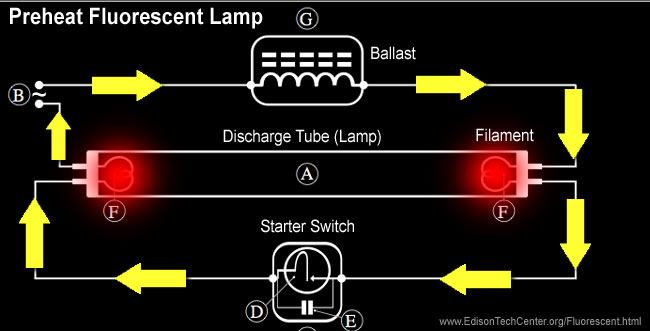
When you turn on a fluorescent lamp, the first step prepares the electrodes at each end of the tube. In most systems, these coiled tungsten filaments are heated to around 900 to 1100 degrees Celsius. This heating enables thermionic emission, where electrons are boiled off the electrode surface into the tube. The ballast supplies this preheating current through either a separate circuit or a starter switch, depending on the system design. This soft start reduces wear on the electrodes and extends lamp life.
High-Voltage Arc Initiation
Once the electrodes are hot, the ballast generates a high-voltage pulse ranging from 600 to 2500 volts. This surge overcomes the gas is resistance and kicks-start an electrical arc. The gas fill, typically argon or krypton, begins to conduct electricity as free electrons collide with gas atoms, creating a plasma. This plasma path allows current to flow continuously through the tube.
Mercury Vapor UV Emission
With the arc established, current flows steadily through the plasma. The real magic happens when fast-moving electrons collide with mercury atoms vaporized inside the tube. Mercury, present in tiny droplets of 3 to 15 milligrams, vaporizes quickly during operation. When electrons strike mercury atoms, they boost electrons within the atoms to higher energy levels. As these excited electrons fall back to their ground state, they release energy in the form of ultraviolet photons, primarily at a wavelength of 253.7 nanometers.
Phosphor Conversion to Visible Light
The inner surface of the glass tube is coated with a phosphor blend, a mix of inorganic compounds like europium and terbium-doped materials. When UV photons strike this coating, the phosphors absorb the high-energy radiation and fluoresce, re-emitting the energy as visible light. This process is called down-conversion. Different phosphor mixtures produce different color temperatures, from warm white at 2700K to daylight at 6500K. Modern triphosphor blends offer high color rendering above 80, while older halophosphate coatings were less efficient with a greenish tint.
Ballast Regulation During Operation
After ignition, the lamp enters steady-state operation. The ballast now shifts from starting mode to current regulation. Fluorescent lamps have negative differential resistance, meaning as current increases, resistance drops, which could lead to runaway current and destruction. The ballast prevents this by acting as a current limiter through inductive impedance in magnetic ballasts or high-frequency switching in electronic ballasts. This ensures stable light output even with minor voltage fluctuations.
Essential Components Inside the Lamp

Glass Tube Structure and Varieties
The fluorescent lamp body is a sealed glass tube, typically made of soda-lime or borosilicate glass. Its shape varies significantly across models. Straight tubes come in T12, T8, and T5 sizes, where the T number refers to eighths of an inch, so a T8 tube is 1 inch in diameter. Other shapes include U-shaped, circular called Circline, and folded designs found in compact fluorescent lamps. Tube lengths range from 100 millimeters in miniature lamps to 2.43 meters in commercial fixtures.
Gas Fill and Mercury Vapor
Inside the tube is a low-pressure gas mixture. Argon is most common because it supports the Penning effect, where metastably excited argon atoms transfer energy to mercury atoms, improving ionization efficiency and lowering required voltages. Alternatives like krypton or neon are used in specialty lamps. The tube also contains 3 to 15 milligrams of mercury, which vaporizes during operation. Total internal pressure is only about 0.3 percent of atmospheric pressure, with mercury vapor pressure around 0.8 pascals in standard lamps.
Phosphor Coating Types
The phosphor coating is the key to visible light production. Applied as a fine powder about 10 micrometers in particle size, it is baked onto the glass to form a durable layer. It must be thick enough to absorb all 254 nanometer UV but not so thick that it reabsorbs visible light. Common types include halophosphate, which is older and cheaper with moderate color rendering of 50 to 70, triphosphor blends with blue, green, and red-emitting phosphors and color rendering above 80, and rare-earth phosphors used in high-end lamps with superior color quality.
Hot Cathode Versus Cold Cathode Electrodes
Electrodes at each end of the tube emit electrons to sustain the arc. Hot cathode electrodes are tungsten coils coated with barium, strontium, and calcium oxides to enhance electron emission. They are used in most fluorescent tubes and CFLs and require preheating. Cold cathode electrodes have no heating element and rely on high electric field for emission. They are more robust, last over 25,000 hours, but are less efficient. Cold cathodes are used in signage, LCD backlights, and nixie tubes.
Why the Ballast Is Critical
Preventing Current Runaway
Fluorescent lamps cannot run directly on line voltage. Their negative resistance characteristic means current would spike uncontrollably without regulation. The ballast prevents this by limiting current flow. It also provides the high-voltage pulse needed to start the arc and, in many systems, preheats the electrodes. Without a ballast, connecting a fluorescent tube directly to 120 volts AC causes an instant flash and failure.
Magnetic Versus Electronic Ballasts
Two main ballast types exist. Magnetic ballasts use an inductor coil with an iron core and operate at line frequency of 50 or 60 hertz. They are about 80 to 85 percent efficient and cause visible flicker at 100 or 120 hertz. They produce an audible hum from magnetostriction and are found in older fixtures. Electronic ballasts use high-frequency semiconductor circuits operating at 20 to 60 kilohertz. They are about 90 percent efficient, eliminate flicker, and are much smaller and lighter. Electronic ballasts are now standard in modern installations.
Benefits of High-Frequency Operation
Operating at 20 to 60 kilohertz instead of 50 or 60 hertz offers major advantages. Lamp efficacy improves by about 10 percent due to more stable plasma. There is no perceptible flicker, making it ideal for video and sensitive environments. Smaller inductors are needed because inductive reactance increases with frequency, allowing smaller components for the same impedance. Electrode wear is reduced, extending lamp life.
Different Starting Methods
Preheat Start with Glow Starter
Common in older 220 to 240 volt systems, this method uses a glow starter containing a bimetallic switch in neon or argon gas. When power is applied, current flows through the ballast, electrodes, and starter. The starter heats up, closes the switch, and heats the filaments. After one to two seconds, the starter cools and opens, allowing the ballast to generate a high-voltage pulse that ignites the arc. You hear a characteristic chick-chock sound during startup.
Instant Start Systems
These apply high voltage up to 1500 volts directly across cold electrodes with no preheating. The tube uses a single-pin base or recessed contacts. While energy-efficient because there is no filament power consumption, this method causes more cathode sputtering, reducing lamp life, especially with frequent switching. Instant start is best for applications where lights stay on for long periods.
Rapid Start Operation
The ballast continuously heats the electrodes via separate windings. This allows a lower starting voltage and smoother ignition, and no starter is needed. Although it uses a bit more energy due to constant heating, rapid start maximizes lamp life and is ideal for areas with frequent on/off cycles.
Programmed Start for Frequent Switching
Used with electronic ballasts, this method uses a microcontroller to optimize startup. It preheats filaments at high frequency, gradually reduces frequency toward resonance, and when voltage peaks, the lamp ignites gently. This minimizes cathode wear, making it perfect for motion-sensor lighting. It also detects failed lamps and stops repeated starting attempts, protecting the system.
Performance and Efficiency Metrics
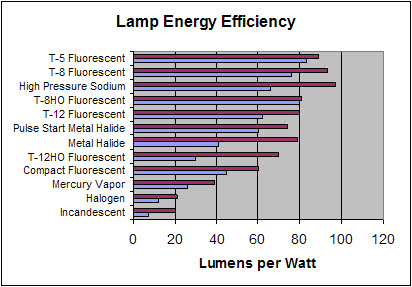
Luminous Efficacy Comparison
Fluorescent lamps produce 50 to 100 lumens per watt, far surpassing incandescent bulbs at 10 to 17 lumens per watt. This means fluorescents are 4 to 6 times more efficient. Some high-output models reach 105 lumens per watt. In comparison, modern LEDs can exceed 200 lumens per watt, which explains why LEDs are replacing fluorescents in most applications.
Where Energy Losses Occur
Not all energy becomes light. Major losses include phosphor conversion, where the Stokes shift causes about 55 percent of UV energy to be lost as heat. Ballast loss is about 10 percent in electronic types and higher in magnetic types. Electrode voltage drop loses several volts per end. Some energy becomes heat in the mercury plasma column, and imperfect phosphor performance allows some UV absorption and light reabsorption.
Lamp Life Factors
Lamp life ranges from 10,000 to 45,000 hours depending on ballast type and usage. Rapid start and programmed start systems provide the best life by being gentle on electrodes. Instant start systems provide the worst life due to high cathode sputtering. Frequent switching can reduce life by up to 50 percent in instant-start systems. Ballast life varies from 10,000 to 50,000 hours depending on quality and heat management.
Color Quality Specifications
Color Rendering Index measures how accurately colors appear under the light. Halophosphate lamps have a CRI of 50 to 70, while triphosphor lamps exceed 80, suitable for offices and retail. Color temperature ranges from 2700K warm white to 6500K daylight, with typical office lighting around 5600K. Ballast factor ranges from 0.7 to 1.2, indicating light output relative to a reference ballast.
Temperature Effects on Performance
Optimal Operating Temperature
Fluorescent lamp performance depends on bulb wall temperature, which affects mercury vapor pressure. The ideal cold spot temperature is about 40 degrees Celsius or 104 degrees Fahrenheit. If the tube is too cold, mercury does not vaporize enough and light output suffers. If too hot, pressure rises and efficiency drops. This is why fluorescents may start slowly in cold garages or fail in enclosed fixtures that overheat.
Amalgam Technology for Wider Range
To stabilize mercury pressure over a wider temperature range, many lamps use amalgam, a mercury alloy with indium, tin, or bismuth. This allows consistent output from negative 20 degrees Celsius to 60 degrees Celsius. CFLs often include heat-dissipating fins or deformed tube shapes to manage the cold spot and prevent overheating in enclosed fixtures.
Special Fluorescent Lamp Types
Compact Fluorescent Lamps
CFLs are folded or helical tubes with an integrated electronic ballast in the base, designed to replace incandescent bulbs. They screw into standard E27 sockets. Invented by Edward Hammer at GE in 1976, they were not commercialized until the 1990s. Single-envelope CFLs may emit measurable UV-B and trace UV-C, up to 10 times more than incandescents. Double-envelope or coated CFLs block most UV, making them safer for close-proximity use.
Cold-Cathode Fluorescent Lamps
CCFLs operate with high voltage and low current using no thermionic coating. They last over 25,000 hours and are used in LCD backlights, signage, and architectural lighting. Their ability to be bent into complex shapes makes them ideal for decorative applications. However, they are less efficient due to high cathode fall voltage.
Germicidal UV Lamps
Identical in construction to standard fluorescents but without phosphor coating, germicidal lamps use fused quartz glass transparent to UV-C. They emit 253.7 nanometer UV-C directly to kill bacteria and viruses. These lamps are ideal for water purification, air disinfection, and medical sterilization. They must be used in enclosed systems to prevent harmful human exposure.
Flicker, EMF, and Light Quality Issues
Understanding and Eliminating Flicker
All AC-powered fluorescents flicker at twice the mains frequency, 100 or 120 hertz. With magnetic ballasts, this flicker is often visible and has been linked to eye strain, headaches, and migraines. It can also appear as banding in videos. Electronic ballasts eliminate this by operating at 20 to 60 kilohertz, rendering flicker imperceptible. Increased flicker or swirling light is a common end-of-life sign.
Electromagnetic Field Considerations
Magnetic ballasts emit low-frequency EMF at 50 or 60 hertz plus harmonics. Electronic ballasts generate high-frequency fields at 30 to 60 kilohertz. Field strength decreases rapidly with distance. Despite concerns, no conclusive evidence links fluorescent EMF to health risks within international safety limits established in 2006.
Blue Light and UV Emissions
Fluorescent lamps can be designed to emit more blue light in the 400 to 500 nanometer range, mimicking daylight and boosting alertness. However, single-envelope CFLs may emit UV-A, UV-B, and trace UV-C, especially if the phosphor is damaged. These emissions are minimized in double-envelope designs. All lamps must comply with IEC photobiological safety standards covering 200 to 3000 nanometers.
Historical Development and Legacy
Early Scientific Discoveries
The story begins in 1852 when Sir George Stokes coined the term fluorescence after observing glowing minerals. In 1856, Heinrich Geissler invented the Geissler tube, the first gas-discharge lamp. Alexandre Edmond Becquerel demonstrated fluorescence in discharge tubes in 1859. Nikola Tesla experimented with electrodeless induction lamps in 1891, and Daniel McFarlan Moore developed efficient nitrogen-based tubes in 1895.
Commercial Breakthrough
In 1901, Peter Cooper Hewitt patented the first mercury-vapor lamp, emitting blue-green light. The key breakthrough came in 1934 when George Inman and his team at General Electric developed the first practical fluorescent lamp using UV excitation and phosphor conversion. It launched commercially in 1938 as the Mazda F series. Some historians argue GE delayed fluorescent commercialization due to incandescent dominance, possibly delaying widespread adoption by two decades.
Environmental and Safety Considerations
Mercury Content and Handling
Every fluorescent lamp contains 3 to 15 milligrams of mercury, essential for UV generation. While safe during normal use, broken lamps release mercury vapor requiring careful cleanup. You should ventilate the room, avoid vacuuming, and use sticky tape to collect debris. The EPA recommends recycling all fluorescent lamps as universal waste. In many regions, fluorescent lamps must be recycled, not thrown in regular trash.
Disposal Requirements
Specialized facilities recover mercury, glass, and phosphors from recycled lamps. Some jurisdictions mandate recycling by law. Always check local regulations for proper disposal. The recycling process prevents mercury from entering landfills and protects environmental health.
Why LEDs Are Replacing Fluorescents
LED Advantages
LEDs now dominate due to higher efficiency reaching up to 200 lumens per watt, longer lifespan exceeding 50,000 hours, no mercury content, instant on/off and better dimming capability, and no ballast needed since they use constant-current drivers. These advantages make LEDs the clear choice for new installations.
Retrofitting Options
Existing fluorescent fixtures can be upgraded with LED technology. Ballast-compatible LED tubes, called plug-and-play, use the existing ballast. Ballast-bypass LED tubes require direct wiring but are more efficient. While fluorescent technology is declining, it remains relevant for maintaining legacy systems and educational purposes.
Frequently Asked Questions About Fluorescent Lamps
How does a fluorescent lamp produce light?
A fluorescent lamp produces light through a three-stage process. First, an electrical arc heats mercury vapor inside the tube, causing it to emit ultraviolet light at 253.7 nanometers. Second, this UV light strikes the phosphor coating on the tube interior. Third, the phosphors absorb the UV energy and re-emit it as visible light through fluorescence.
Why do fluorescent lamps need a ballast?
Fluorescent lamps have negative resistance characteristics, meaning current would increase uncontrollably without regulation. The ballast limits current flow to safe levels, provides the high-voltage pulse needed to start the arc, and in many systems preheats the electrodes. Without a ballast, connecting a fluorescent lamp directly to line voltage causes instant failure.
What causes fluorescent lamp flicker?
Flicker occurs at twice the mains frequency, 100 or 120 hertz. With magnetic ballasts, this flicker is often visible and can cause eye strain. Electronic ballasts operate at 20 to 60 kilohertz, eliminating perceptible flicker. Increased flicker can also indicate the lamp is reaching end of life.
How long do fluorescent lamps last?
Fluorescent lamp life ranges from 10,000 to 45,000 hours depending on ballast type and usage patterns. Rapid start and programmed start systems extend life by minimizing electrode wear. Instant start systems have shorter life due to increased cathode sputtering. Frequent on/off switching can reduce life by up to 50 percent.
Are fluorescent lamps safe to use?
Fluorescent lamps are safe during normal operation. They contain small amounts of mercury, but the phosphor coating blocks most UV emissions. Broken lamps require careful cleanup due to mercury vapor release. Modern double-envelope CFLs significantly reduce UV emissions. All lamps comply with international photobiological safety standards.
Can fluorescent lamps work in cold temperatures?
Fluorescent lamp performance drops in cold temperatures because mercury vapor pressure decreases, reducing UV output. The optimal operating temperature is about 40 degrees Celsius. Lamps may fail to start in unheated spaces below 10 degrees Celsius. Amalgam lamps extend the cold operating range to negative 20 degrees Celsius.
Key Takeaways for Understanding Fluorescent Lamp Operation
Fluorescent lamps revolutionized lighting by converting electrical energy into visible light through a sophisticated chain reaction involving gas discharge, mercury vapor excitation, and phosphor fluorescence. The ballast plays an essential role in regulating current and providing the high-voltage starting pulse, without which the lamp would destroy itself. While being replaced by LEDs due to their superior efficiency, longer life, and lack of mercury, understanding how fluorescent lamps work provides insight into decades of lighting innovation and the physics that still influence modern design.